


When a Sacred Place Becomes a Photoshoot: Rethinking Tourism at Wat Arun

Updated: Jul 29
Rethinking Tourism at Wat Arun, Bangkok
Cultural Experiences / World Curriculum — By Ms. Mila Vasconcelos
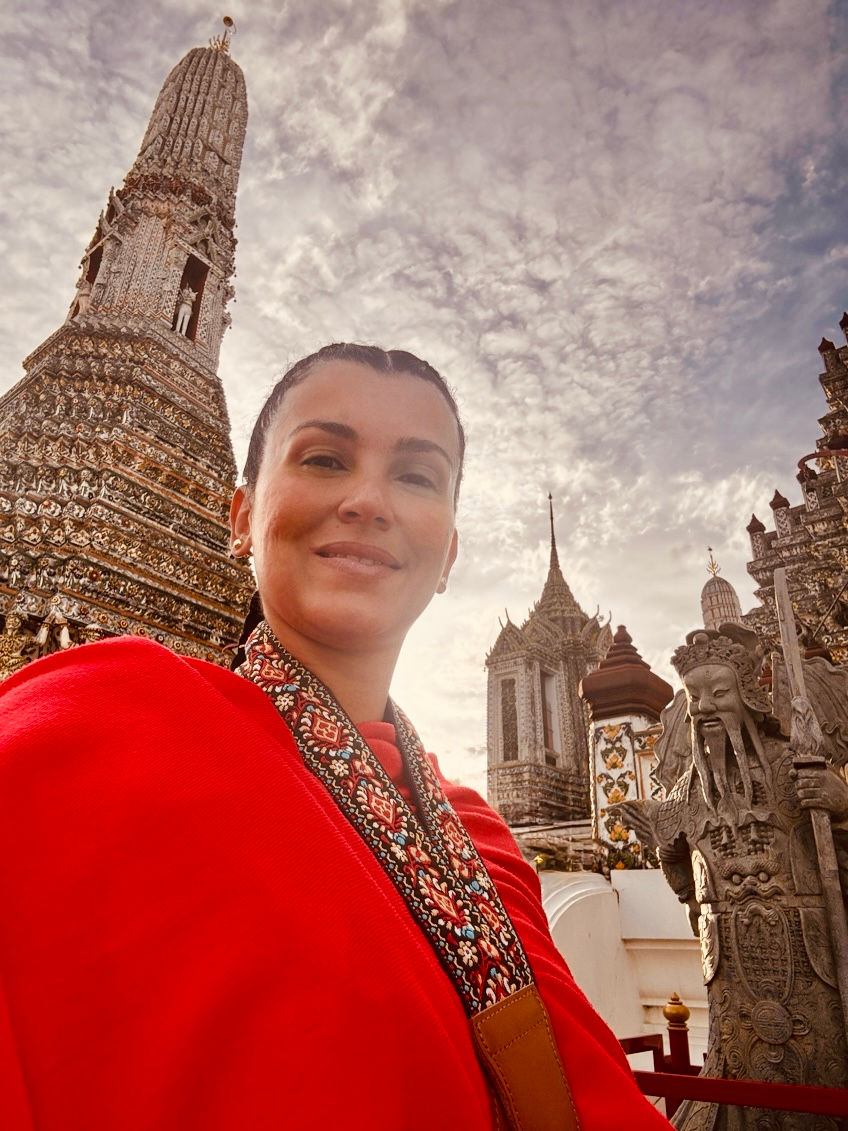
I am back in Thailand now, in July 2026.
Since I came here last time, in the winter of 2024, many places caught my attention, and I could not visit them all at just one time. Now, I am having another chance, with eyes more open and more research experience in my backpack. But that did not mean that I am a know-it-all. Quite the opposite. This visit to Wat Arun allowed me to think deeper about what I am observing. Let me tell the story.
On my first day exploring Bangkok again, I visited Wat Arun Ratchawararam, the Temple of Dawn, one of the city’s most recognizable Buddhist temples. Its central prang has recently entered Thailand’s UNESCO World Heritage Tentative List, beginning a process that may eventually lead to full World Heritage status.
With a beautiful architecture and attention to detail, no wonder why Wat Arun attracts so many tourists every year
On my way there, my concern was simple: I was wearing a summer dress with thin straps. Bangkok was around 38°C, and I wondered whether I would be allowed inside. The woman at the ferry reassured me that I could borrow something to cover myself.
Then I arrived. And suddenly, I felt extremely underdressed.
When Did the Temple Become a Photo Studio?
All around me, visitors were wearing elaborate Thai clothing. Pink silk. Gold embroidery. Traditional accessories. Parasols. And cameras. So many cameras!
Professional photographers were positioned throughout the temple grounds, directing people toward the best angles. Visitors waited for particular staircases, walls and architectural details to become available. People moved from one carefully selected location to another, looking for the photograph that would place the costume, the body and the landmark into one perfect frame.

This is not a small or accidental trend. Traditional Thai costume rental and professional photography around Wat Arun are now actively promoted as tourism experiences, and Thailand’s own tourism authority presents the temple area as a major location for costume rental and photography.
My first reaction was uncomfortable.
I watched people from many countries, cultures, and religions competing for the best place under the sun (and under the landmark), and I started asking the questions that have increasingly followed me through my travels.

When does cultural appreciation become performance?
When does traditional clothing become a costume?
What happens when a sacred place becomes a background?
Looking Through the Researcher’s Lens
I began evaluating the scene almost automatically.
Who benefits from this?
What is culturally meaningful about the experience?
What do visitors actually learn about the clothing they are wearing?
What is the impact on the people who use this space for prayer and religious practice?
And perhaps the most uncomfortable question:
Was I witnessing cultural exchange, cultural commodification, or simply another form of global tourism designed for social media?
From my perspective, the answer seemed obvious. But then I decided to speak to a monk, a Thai citizen and Buddhism student, who is also the office assistant of the temple, named Phrama Jakrawuth Cakkamedhi. With limited English but a great willingness to help, and with the use of translation apps, he was able to talk to me and explain a few things. And the conversation complicated everything.
The Monastery, office, and ritualistic monk life are not affected by the tourists, following rules separating time and spaces from the busy tourist crowds.
The Answer I Was Not Expecting
I wanted to understand how someone connected to the temple saw what was happening around us. His response was far more open than mine.
He explained that when someone comes to Thailand, visits a place as beautiful as Wat Arun, photographs it and shares it, even through social media, that image can create curiosity. Someone sees the photograph, they become interested in the place, then perhaps they begin to ask questions about Thai culture.
From his perspective, visibility did not automatically remove meaning. A photograph could become an entry point.
This was already enough to challenge my first interpretation. But he continued.
The religious life of the temple, he explained, is protected. Times and areas are reserved for prayers, ceremonies, and monastic practices. Tourists do not have unrestricted access to everything.
I had actually noticed evidence of this myself. Information displayed at the temple explained the recitation of the Pāṭimokkha, the monastic rules, and stated clearly that the space used for this practice was restricted to monks. The sacred life of the temple had not disappeared. I simply could not see all of it.
The Question of Money
Then came the part of the conversation that is often uncomfortable to discuss: Tourists bring money.
Entrance fees, costume rentals, photographers, ferries and surrounding businesses form an economy around the site. From the monk’s perspective, visitors also help sustain the place.
This does not automatically solve the problems of overtourism. It does not mean every form of tourism is respectful. It does not answer questions about who receives the money, how much pressure a site can support, or whether cultural practices begin to change in response to visitor expectations.
But it made my original position harder to maintain.
I had arrived looking at tourists and wondering whether they were taking something from the place.
The monk was asking me to consider what their presence might also give.
Culture Is More Complicated Than My First Reaction
This is the part of research I value most.
Sometimes I arrive somewhere with a question, sometimes I arrive with a concern, and sometimes, if I am not careful, I arrive with an answer already forming in my head. Today reminded me why I need to resist that.
My discomfort with touristification is still there. I still struggle when sacred spaces become crowded stages for photographs. I still question what happens when traditional clothing is rented without any understanding of its history, symbolism, or context. I still worry about the growing pressure to transform cultural experiences into content.
But I can no longer look at the scene from one position alone.
The tourist sees an experience.
The photographer sees an image.
The rental business sees an income.
The researcher sees a tension.
The monk may see visibility, curiosity, and financial sustainability.
And the sacred space continues to exist among all of them.
Final Reflection
I left Wat Arun with fewer certainties than I had when I arrived. For me, that is a good result.
I could have photographed the crowds, criticized the costumes and written another article about tourism turning culture into content. Some of that critique would have been valid. But it would have been incomplete.
The conversation with the monk did not erase my concerns. It expanded the number of people I needed to consider before reaching a conclusion.
Perhaps this is what I am beginning to understand through this research: culture is rarely preserved by keeping it completely still. It moves through people, images, money, rituals, institutions and encounters. Sometimes that movement creates curiosity. Sometimes it creates distortion. Often, both processes are happening at the same time.
So I am leaving this experience with questions rather than a verdict:
Who has the right to decide when cultural participation becomes cultural performance?
Can a tourist experience be superficial for one person and still create meaningful curiosity in another?
Can social media contribute to the commodification of a sacred place while also helping sustain and promote it?
And if the people connected to a cultural practice see value where I initially see a problem, how should that change the way I conduct my research?
I still do not know exactly where I stand.
But today, at Wat Arun, I was reminded that my role as a researcher is not to arrive in a place and decide what culture means. It is to observe, to ask, and most important, to listen.
And, when necessary, to allow the people I meet to change the question.
Camila Vasconcelos


rr88 có dễ xem không? Mình tự trả lời là khá ổn, vì vào trang chủ là thấy bố cục được chia thành từng khối rõ ràng, lướt xuống vẫn đi theo một mạch nên mắt không bị “ngợp” như mấy trang hay nhồi chữ. Mình chỉ định xem thử cho biết thôi, mà đọc lướt vài đoạn thấy họ ghi khá cụ thể về việc nền tảng bắt đầu từ 2018 và đặt trụ sở ở Philippines, kiểu đưa thông tin có mốc đàng hoàng chứ không nói chung chung (mình thích mấy chi tiết có thời gian như vậy). Thanh menu để chỗ dễ nhận ra, tiêu đề các box tách bạch nên nhìn một cái là biết…
Mình thường đọc mấy bài soi kèo, phân tích cầu để lấy thêm góc nhìn trước khi quyết định, nhưng luôn tự nhắc chỉ xem như tham khảo. Hồi trước mình hay bị tâm lý “suýt trúng” nên dễ ham gỡ rồi tăng tiền, sau này mới học cách đặt mức dừng và thấy lệch nhịp là nghỉ luôn. Có thời gian mình thử theo Soi cầu VIP, điểm mình thích là họ hay nói rõ vì sao lại ra hướng đó, đọc xong hiểu được logic chứ không phải chỉ quăng con số. Dù vậy mình vẫn chọn chơi kiểu bình tĩnh: ít lựa chọn thôi, ghi lại kết quả để biết mình hợp dạng nào, tránh bị kéo…